

Blog · March 18, 2024
Advertising Costs on Google (2024): Google Ads
Google Ads is a popular platform for promoting businesses online. How much does it cost? Here’s the breakdown.
Welcome to this blog post on internet advertising costs in 2024! In this article, I’ll break down the cost of advertising on Google Ads, one of the most popular online advertising platforms.
You’ll also learn about the pay-per-click (PPC) method and the difference between Google Ads Search and Google Ads Display, along with the costs tied to each. I’ll also share useful data on average click-through rate and average conversion rate.
Keep reading to learn more!
Advertising on Google
What does advertising on Google cost?
To promote your business on Google, you’ll need to use the pay-per-click (PPC) method. This advertising method involves paying Google a sum of money to display your products or services in a specific placement.
One advantage of this method is that you only pay if someone clicks your ad. That means if a thousand people see your ad and none of them click it, you don’t pay anything.
It’s worth noting that advertising on Google comes in two formats: Google Ads Search and Google Ads Display.
Google Ads advertising costs
Now let’s look at the pricing, specifically the cost per click (CPC) of ads across different market sectors. The data comes from WordStream (2019).
| Industry | CPC (Search, USD) | CPC (Display, USD) |
|---|---|---|
| Travel | $1.53 | $0.44 |
| Technology | $3.80 | $0.51 |
| Industrial services | $2.56 | $0.54 |
| Employment services | $2.04 | $0.78 |
| Consumer services | $6.40 | $0.81 |
| Health & medical | $2.62 | $0.63 |
| Legal | $6.75 | $0.72 |
| Finance & insurance | $3.44 | $0.86 |
| Education | $2.40 | $0.47 |
| E-commerce | $1.16 | $0.45 |
| Dating | $2.78 | $1.49 |
| Real estate | $2.37 | $0.75 |
| B2B | $3.33 | $0.79 |
| Automotive | $2.46 | $0.58 |
| Home goods | $2.94 | $0.60 |
| Attorneys | $1.43 | $0.62 |
Taking into account the sector costs from the table above, we can say that the average price per click across all sectors on Google Ads Search is $2.69 USD.
Meanwhile, on Google Ads Display, the average price per click across all sectors is $0.63 USD.
Now, going back to the two Google advertising formats, let’s see how Google Ads Search and Google Ads Display actually work.
Google advertising
Google Ads Search
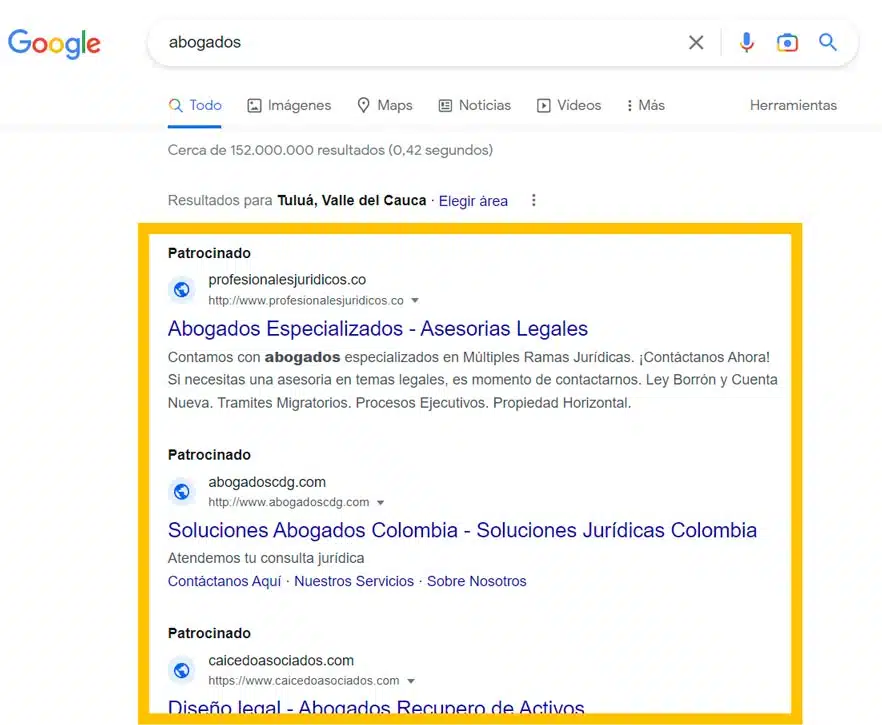
Google Ads Search is an advertising format that lets you appear on the Google results page, also known as the SERP (Search Engine Results Page). It’s an effective way to promote your products or services to users who are searching for something related to what you offer.
Average CTR in Google Ads Search
As a reminder, CTR refers to the ratio between the number of times an ad is shown and the number of clicks it receives. According to WordStream, the average click-through rate (CTR) for a Google Ads Search campaign is 3.17%.
In other words, out of every 100 people who see your ad, only three click on it.
As for the average conversion rate, it stands at 3.75%. That means, out of every 100 people who click your ad, only 4 will complete a purchase.
Google Ads Display
Google Ads Display advertising lets you show your brand’s ads on websites of your choosing. One of its main advantages is that you can appear on high-traffic sites and boost your brand recognition (top of mind awareness) at no extra cost.

Another standout advantage of Google Ads Display advertising is that you only pay for the clicks your ad receives. That means if someone simply sees your ad but doesn’t click it, you don’t pay a thing. In other words, plenty of people may see your ad without you spending a single cent on advertising.
Average CTR in Google Ads Display
The average click-through rate (CTR) for a Google Ads Display campaign is 0.46%, meaning only one out of every 200 people who see your ad will click it. Likewise, the average conversion rate is 0.77%, meaning that out of every 100 people who click your ad, only one will make a purchase.
Average click-through rate (CTR)
on Google by industry
It’s important to keep in mind that average CTR on Google varies depending on the industry advertising.
| Industry | Avg. CTR (Search) | Avg. CTR (Display) |
|---|---|---|
| Technology | 2.09% | 0.39% |
| Consumer services | 2.41% | 0.51% |
| B2B | 2.41% | 0.46% |
| Employment services | 2.42% | 0.59% |
| Home goods | 2.44% | 0.49% |
| Industrial services | 2.61% | 0.50% |
| E-commerce | 2.69% | 0.51% |
| Finance & insurance | 2.91% | 0.52% |
| Legal | 2.93% | 0.59% |
| Health & medical | 3.27% | 0.59% |
| Real estate | 3.71% | 1.08% |
| Education | 3.78% | 0.53% |
| Automotive | 4.00% | 0.60% |
| Attorneys | 4.41% | 0.59% |
| Travel | 4.68% | 0.47% |
| Dating | 6.05% | 0.72% |
Generally speaking, for every 100 users who see your ad on Google (whether in Search or Display format), you’ll get between 1 and 3 clicks.
Concrete example (case study)
To illustrate this, let’s say you own a gym and want to promote it to sign up more members. If you decide to run a Google Display campaign, keep in mind that the average cost per click (CPC) in the health sector is $0.63 USD. That means for every user who clicks your ad, you’ll pay Google $0.63 USD.
If you spend $10 USD a day on your campaign ($300 USD a month), you could get up to 16 clicks a day on the banner ad (480 clicks a month). If the conversion rate in the health sector is 0.82%, you’ll need roughly 122 clicks for one person to call the gym and sign up.
With a conversion rate of 0.82% in the health sector, you’d need approximately 122 clicks for one person to call the gym and sign up: (1 / 0.0082 = 121.95). At a cost per click of $0.63 USD, the total cost to get one conversion would be roughly $76.86 USD (122 x 0.63 = 76.86).
So with a monthly investment of price in your MD account, you could get roughly 3 conversions (300 / 76.86 = 3.9). Since you can’t have a fraction of a conversion, the actual number of conversions would be 3 or 4 per month.
You can apply this same formula to work out how profitable advertising your own business’s services would be.
Factors that affect Google Ads advertising costs
It’s worth noting that advertising costs on Google can vary depending on several factors, such as competition in your sector, the relevance and quality of your ads, your campaign budget, the condition and optimization of your website, choosing the right keywords, geographic location, and the time of day your ads are shown, among others.
That’s why it’s essential to do detailed market research and carefully plan your Google Ads advertising strategy to optimize your results and get the best possible return on investment.
Ultimately, advertising on Google is a powerful tool for promoting your products or services online and attracting potential customers. Still, it’s important to understand the costs and ad formats involved in order to build an effective, profitable advertising strategy.